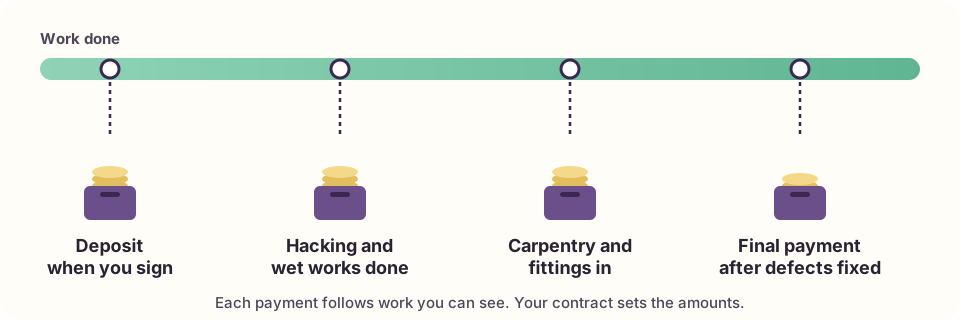
The safest renovation payment schedule follows the work: each payment comes due when you can see the stage it pays for. Then if a firm stops work or closes, you’ve lost as little as possible.
Why it matters
Renovation is where Singapore consumers lose the most money paid in advance. CASE reported that renovation accounted for about S$728,000 in prepayment losses in 2024, the highest of any sector, and it received 962 complaints against renovation contractors that year.
What CASE suggests
CASE’s tips for prepayment protection suggest asking for:
- a 10% deposit when you sign the contract;
- 80% in stages, as each step of the works is completed;
- the final 10% 14 days after satisfactory completion of all works.
This is advice, not law. Your contract sets the actual amounts, and the consumer regulator’s brochure says that if you pay progressively, the payment schedule should line up with the agreed work schedule.
How CaseTrust protects deposits
If the firm is CaseTrust-accredited, the scheme’s rules give you more protection:
- the initial deposit is capped at 20% of the total cost;
- payments are collected in phases at agreed milestones;
- the firm must buy a deposit performance bond that protects your deposit if it closes, is wound up or goes into liquidation;
- after paying, you receive proof of protection showing your details and the protected sum.
Check accreditation on CaseTrust’s own list: see checking a contractor.
Good habits for every payment
- Tie each payment to a stage you can check, such as hacking finished, tiling done or carpentry installed, not to dates alone.
- Don’t pay for materials far in advance unless they’re made to order, and then ask for the supplier’s invoice.
- Get a receipt every time, naming the stage the payment covers.
- Hold back the last payment until the defects you’ve listed are fixed.
- Pay in a way you can trace. CASE notes that credit card payments may be recoverable through a chargeback if the service isn’t delivered.
- Agree variations in writing first, with their price, so they don’t turn up as a surprise on the next invoice. See what your renovation contract should say.
Renovation loans
Banks offer renovation loans. Under MAS Notice 635, a bank renovation loan is excluded from the S$20,000 minimum annual income rule for other unsecured bank credit only if the money is used for renovation, it’s repaid within 5 years, and the borrower’s renovation loans from that bank total no more than 6 months’ income or S$30,000, whichever is lower. Interest rates and fees vary between banks, so compare them as you would any loan. Plan the budget first: see budgeting for a renovation.
Planning a renovation? Tell us about it
Tell us what you’re planning. The team behind Junk to Clear, which handles renovations, will get back to you with a quote.
Thank you. Your enquiry is on its way.
The team will contact you on the number you gave. You don’t need to do anything else.
Questions people ask
How much deposit should I pay for a renovation?
As little as you can agree. CASE suggests a 10% deposit on signing. CaseTrust-accredited renovation businesses may not take an initial deposit of more than 20% of the total cost, and must protect deposits with a performance bond.
When should I make the final payment?
After the works are complete and any defects you listed are fixed. CASE suggests paying the last 10% 14 days after satisfactory completion of all works, which gives you time to find problems while you still hold some of the money.
Can I take a renovation loan?
Banks offer them. Under MAS rules, a bank renovation loan is exempt from the minimum income rule for other unsecured credit only if it’s used for renovation, repaid within 5 years, and all the borrower’s renovation loans from that bank come to no more than 6 months’ income or S$30,000, whichever is lower. Check the terms with your bank.
Should I pay by credit card?
CASE notes that people who pay by credit card may be able to recover prepayments through a chargeback with their card issuer if the goods or services aren’t delivered. Ask whether the firm accepts cards and whether it charges extra for them.
Sources
Renovation rules change. We checked this guide against these official pages on 5 October 2026. If a source says something different from this guide, the source is right, and your HDB branch, condo management or BCA has the final word on your own home.
- CASE — Tips for prepayment protection (infographic)
- CASE — CaseTrust Accreditation for Renovation Businesses
- CASE — Media release on 2024 complaints and prepayment losses (6 February 2025)
- Competition and Consumer Commission of Singapore — Fair Trading Practices for the Renovation Industry (brochure, PDF)
- MAS — Notice 635, Unsecured Credit Facilities to Individuals (PDF, revised 13 May 2022)
SpaceToReno is run by the team behind Junk to Clear, which also handles renovations. Where a guide links to Junk to Clear or a sister site, it’s because that step calls for the service, and the sentence says so. Enquiries sent through the form go to the same team. How SpaceToReno works